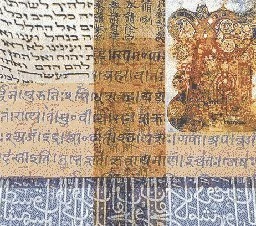
Bible
Anthology of sacred texts for Judaism and Christianity.

The Bible is an anthology of religious texts central to Christianity and Judaism, and important in other Abrahamic religions such as Islam. It includes instructions, stories, poetry, letters, prophecies, and other genres, compiled by different religious communities into various official collections called biblical canons. Believers generally consider the Bible to be a product of divine inspiration, though interpretations vary.
- Estimated total sales
- over five billion copies
- Original languages
- Hebrew, Aramaic, Koine Greek
- Number of books in Hebrew Bible
- 24
- Number of testaments in Christian Bible
- 2 (Old and New)
- Current translation status
- translated or being translated into about half of the world's languages
Lore & Background
The Bible's development is complex and not fully understood. The oldest books began as songs and stories transmitted orally. Writing and orality were intertwined, with ancient writing learned in communal oral performance. The texts were written and compiled by many people, mostly unknown, from a variety of cultures and backgrounds over a period of enormous political, cultural, and ecological change. The oldest parts of the Hebrew Bible, such as the Song of Deborah, may have roots in oral traditions dating to c.
Reader's Guide
The Bible has had a profound influence on Western culture and history and on cultures around the globe. The study of these texts through biblical criticism has also indirectly impacted culture and history. Some view biblical texts as morally problematic, historically inaccurate, or corrupted by time; others find them a useful historical source or a source of ethical teachings. The Christian Bible is the best-selling publication of all time, with estimated total sales of over five billion copies. The Hebrew Bible, or Tanakh, is divided into the Torah, Nevi'im, and Ketuvim. The Christian Bible is divided into the Old Testament (a reorganization of the Hebrew Bible and deuterocanonical books) and the New Testament, which includes gospels and Pauline epistles originally written in Koine Greek, mostly in the 1st century CE.
Did You Know?
- The English word 'Bible' derives from Koine Greek 'ta biblia', meaning 'the books'.
- The Masoretic Text, a medieval edition, is considered the authoritative text of the Hebrew Bible by most branches of modern Rabbinic Judaism, though some groups like Karaite Judaism do not accept it as exclusively author
- Clement of Alexandria and Origen are earlier writers who used the Greek phrase 'ta biblia' to describe both the Old and New Testaments together.
A Tapestry of Voices Across Millennia
The Bible is not the work of a single author or era but a vast anthology assembled over roughly thirteen centuries. Its oldest material—scholars point to the Song of Deborah and the Samson narratives—may trace back to around 1200 BCE, the premonarchial early Iron Age. From there, the collection absorbed texts reflecting nomadic life, established monarchies with Temple worship, the trauma of Babylonian exile, fierce foreign oppression, courtly sophistication, and the wanderings of charismatic preachers. British scholar John K. Riches noted that the span of composition encompasses the literary output of Homer, Plato, Aristotle, Thucydides, Sophocles, Caesar, Cicero, and Catullus, alongside the rise and fall of Assyrian and Persian empires, Alexander's campaigns, and Rome's Mediterranean domination. The authors, many scholars agree, are mostly unknown, drawn from disparate cultures and backgrounds. The earliest texts began as songs and stories passed orally from generation to generation before being committed to papyrus scrolls by hand. No original manuscripts survive; the oldest substantial copies are the Dead Sea Scrolls from Qumran, dated between 250 BCE and 100 CE.
Structure, Canon, and the Many Bibles
The Bible exists in multiple canonical forms depending on the religious community that compiled it. The Hebrew Bible, originally written in Hebrew with portions in Aramaic, is divided into three sections: the Torah (Teaching), Nevi'im (Prophets), and Ketuvim (Writings), collectively known by the acronym Tanakh. The Masoretic Text, a medieval edition, holds authoritative status across all branches of modern Rabbinic Judaism. The Christian Bible reorganizes these same books into the Old Testament, adding deuterocanonical books drawn from historical editions, and pairs them with the New Testament. Christianity emerged as an outgrowth of Second Temple Judaism, and the early Church continued the Jewish practice of incorporating inspired, authoritative writings. The gospels—narratives of Jesus's life and teachings—along with the Pauline epistles and other texts coalesced into the New Testament, composed mostly in the first century CE in Koine Greek. Believers across traditions generally regard the Bible as divinely inspired, yet they differ significantly in how they understand that inspiration and interpret the text.
From Papyrus to 'The Books'
The very name "Bible" carries a material history. The English word descends from Koine Greek ta biblia, meaning "the books," a diminutive of byblos, referring to Egyptian papyrus—possibly named after the Phoenician seaport Byblos, from which papyrus was exported to Greece. In Hellenistic Jewish communities, the phrase ta biblia served as a natural label for their sacred collection. The biblical scholar F. F. Bruce identified John Chrysostom, in his Homilies on Matthew delivered between 386 and 388 CE, as the earliest known writer to apply the Greek phrase to both the Old and New Testaments together. The Latin rendering biblia sacra, "holy books," was a translation of the Greek tà biblía tà hágia. In medieval Latin, the plural biblia gradually solidified into a feminine singular noun, and from there it was borrowed as a singular word into the vernacular languages of Western Europe, becoming the familiar "Bible" we use today.
Global Reach and Enduring Influence
With estimated sales exceeding five billion copies, the Christian Bible stands as the best-selling publication in history. Its influence extends far beyond the page, shaping Western culture and history as well as traditions around the globe. The text is currently translated or in the process of being translated into approximately half of the world's languages, a testament to its ongoing reach. Beyond devotional use, the academic discipline of biblical criticism has indirectly influenced culture and history by subjecting the texts to rigorous linguistic and historiographical scrutiny. Perspectives on the Bible vary widely: some readers find its contents morally problematic, historically inaccurate, or corrupted by the passage of time, while others regard it as a valuable historical source for understanding particular peoples and events, or as a wellspring of ethical teaching. The Bible thus occupies a unique position—simultaneously a sacred anthology, a historical artifact, and a living cultural force whose interpretation remains as contested and diverse as the communities that revere it.
Frequently Asked Questions
What is the Bible?
The Bible is a multi-genre anthology of sacred writings—narratives, poetry, prophecy, letters, and law—that forms the core scripture of both Christianity and Judaism. Rather than a single authored work, it is a collection assembled by different religious communities into official canons over many centuries.
How many books are in the Bible?
The standard Christian canon contains 66 books split into two testaments: 39 in the Old Testament and 27 in the New Testament. The Hebrew Bible used in Judaism groups the same material into 24 books, and some Christian traditions add deuterocanonical writings, so the exact total shifts by denomination.
What languages was the Bible originally written in?
The earliest sections were composed in Hebrew, with portions in Aramaic, while the entire New Testament was written in Koine Greek. Today the text has been translated or is in the process of being translated into roughly half of the world's living languages.
Who wrote the Bible?
No single person authored the Bible; it is the product of dozens of writers—prophets, kings, apostles, and others—working across many centuries. Believers in both faiths typically describe these human authors as divinely inspired, although the precise nature and extent of that inspiration is a matter of ongoing theological debate.
More in Christian Sacred Texts 1-24
Elsewhere in the Christian Sacred Texts universe
Spotted an error? Know more?
This is a living reference — every entry is fact-audited, and reader corrections feed straight into our audit queue. Suggest an edit · See this site's audit record